




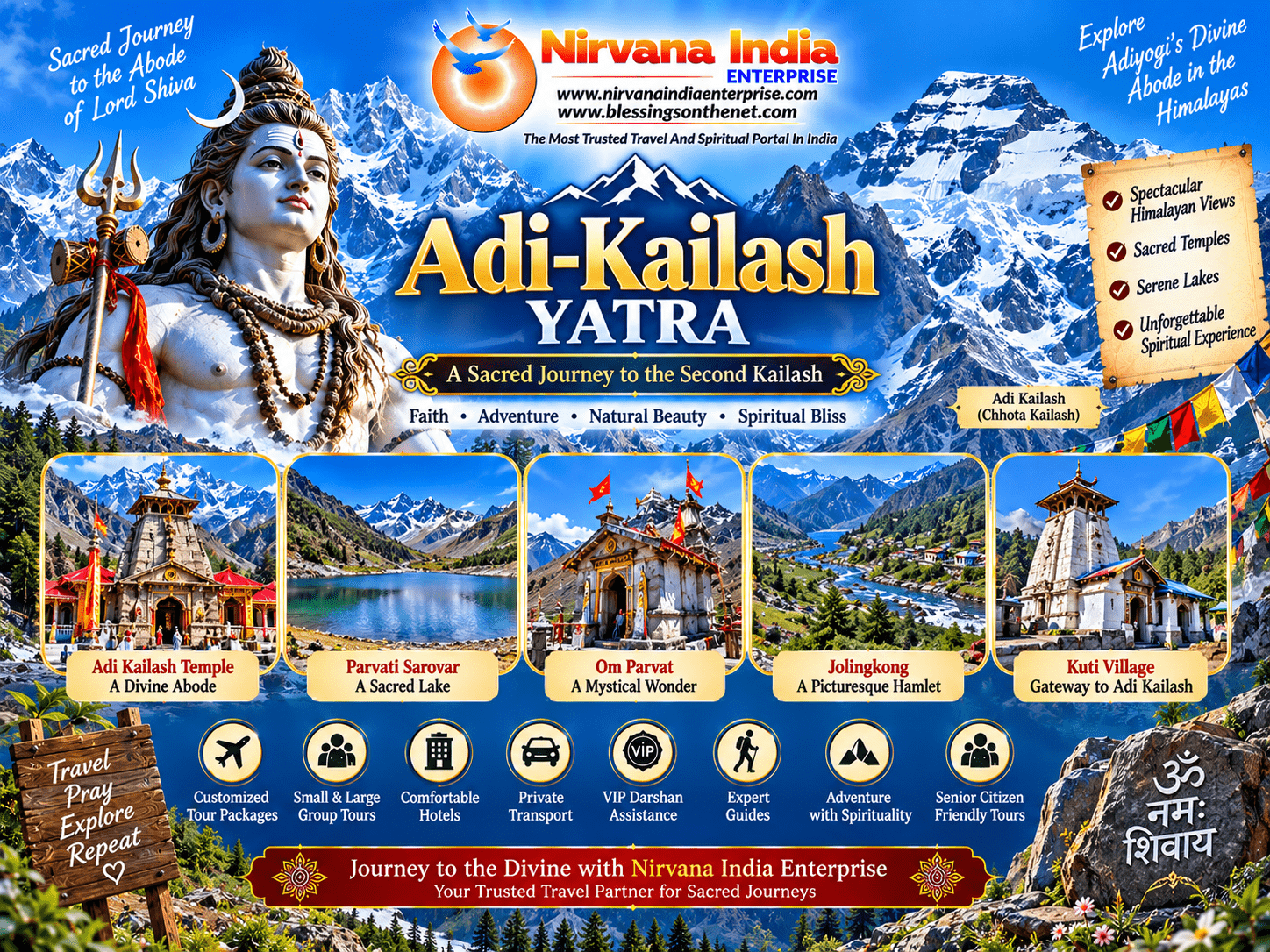
Adi Kailash Yatra A Sacred Journey to the Abode of Lord Shiva
Adi Kailash, also known as Chota Kailash in popular usage, is one of the most revered Himalayan pilgrimage destinations associated with Lord Shiva.
Located in the remote Kumaon region of Uttarakhand, close to the India–Tibet border, Adi Kailash is surrounded by some of the most dramatic landscapes in the Indian Himalayas. Snow-covered peaks, high-altitude valleys, sacred lakes and ancient places of worship combine to create an extraordinary pilgrimage experience.
For devotees of Lord Shiva, however, the importance of Adi Kailash goes far beyond its spectacular scenery.
It is regarded as a sacred Himalayan abode of Mahadev, where the mountains, silence and natural surroundings create an atmosphere of devotion and contemplation.
The journey to Adi Kailash is not simply a mountain expedition.
It is a Shiva Yatra.
What is Adi Kailash?
Adi Kailash is a sacred mountain located in the Kumaon Himalayas of Uttarakhand, in the Pithoragarh district.
Its remote location and distinctive mountain landscape have made it an important pilgrimage destination for devotees undertaking the Adi Kailash Yatra.
The word Kailash immediately evokes the sacred association of Lord Shiva and Mount Kailash in Tibet.
Adi Kailash, however, is geographically distinct from Mount Kailash.
For Indian pilgrims, Adi Kailash has developed its own sacred identity and is traditionally regarded as an important manifestation or abode associated with Lord Shiva.
The journey also provides an opportunity to experience the spiritual heritage of the remote Kumaon Himalayas.
Adi Kailash and Mount Kailash – Are They the Same?
No.
This is an important distinction.
Mount Kailash is located in Tibet and is revered as one of the most sacred mountains in Hinduism, Buddhism, Jainism and Bon traditions.
Adi Kailash is located in Uttarakhand, India.
The two mountains are geographically different, but both are deeply associated with Lord Shiva in Hindu spiritual tradition.
Because of this spiritual association, Adi Kailash is sometimes referred to as Chota Kailash or Little Kailash.
For devotees who cannot undertake the journey to Mount Kailash in Tibet, Adi Kailash has become an important pilgrimage destination within India.
Why is Adi Kailash Sacred?
The spiritual importance of Adi Kailash comes from its association with Lord Shiva and the Himalayan tradition of Shaivism.
The Himalayas have traditionally been regarded as the sacred realm of Shiva.
The mountains represent:
- Meditation
- Renunciation
- Silence
- Tapasya
- Spiritual power
- Detachment
- Divine consciousness
Adi Kailash stands within this extraordinary Himalayan landscape.
For pilgrims, approaching the mountain is therefore not simply reaching a geographical destination.
It is approaching a sacred landscape connected with Mahadev.
The Sacred Landscape Around Adi Kailash
The Adi Kailash Yatra is much more than a visit to one mountain.
The surrounding region contains several places that have become important parts of the pilgrimage experience.
These include:
Adi Kailash
The principal sacred mountain and the spiritual focus of the Yatra.
Parvati Kund
A sacred high-altitude lake associated in Hindu tradition with Goddess Parvati.
The peaceful waters surrounded by towering Himalayan peaks create one of the most memorable sights of the pilgrimage.
Jollingkong
The high-altitude area from which pilgrims approach the Adi Kailash region.
Gauri Kund / Gauri Parvat
Places associated with Goddess Parvati and the Shiva-Parvati tradition.
Om Parvat
One of the most extraordinary sacred mountain formations in the region, where naturally occurring patterns of snow are traditionally perceived as the sacred ॐ symbol.
These destinations together make the Adi Kailash Yatra a deeply spiritual Himalayan experience.
Om Parvat The Sacred ॐ of the Himalayas
For many pilgrims, the Adi Kailash journey becomes even more special because of Om Parvat.
Om Parvat is renowned for the naturally occurring snow formation on the mountain face that resembles the sacred Sanskrit symbol:
ॐ
The symbol Om is one of the most important sacred sounds in Hindu spirituality.
It represents the primordial sound and is associated with the Divine and the essence of existence.
Seeing the natural Om formation against the dark mountain rock has become one of the most remarkable experiences of the Himalayan pilgrimage.
However, Om Parvat and Adi Kailash are two distinct geographical destinations.
A pilgrimage itinerary may include both, but they should not be described as the same mountain.
Adi Kailash and Lord Shiva
The entire Himalayan landscape around Adi Kailash evokes the traditional image of Lord Shiva as the great yogi.
Shiva is:
- Mahadev the Great God
- Yogeshwar Lord of Yoga
- Mahakal Lord beyond Time
- Neelkanth the Blue-Throated One
- Pashupati Lord of All Beings
The remote mountains provide an extraordinary setting for contemplating these aspects of Shiva.
Far away from cities and everyday distractions, the pilgrim encounters vast mountains, cold winds, silence and immense natural beauty.
The experience can become a form of tapasya – a journey requiring faith, patience and endurance.
The Spiritual Significance of Parvati Kund
Parvati Kund is one of the sacred highlights of the Adi Kailash region.
The lake is traditionally associated with Goddess Parvati, the divine consort of Lord Shiva.
The Shiva-Parvati connection gives the landscape a special spiritual significance.
In Hindu tradition, Shiva and Parvati represent a profound divine union.
Shiva represents consciousness.
Parvati represents Shakti divine energy.
Together they symbolise the inseparable relationship between:
Shiva and Shakti
Consciousness and Energy
Stillness and Creation
For pilgrims, visiting Parvati Kund adds another spiritual dimension to the Adi Kailash Yatra.
Adi Kailash – A Journey Through the Kumaon Himalayas
The journey itself is an important part of the pilgrimage.
Unlike conventional temple tourism, the route to Adi Kailash takes travellers through remote Himalayan terrain.
The landscape gradually changes as the road climbs deeper into the mountains.
You encounter:
- Deep valleys
- Himalayan rivers
- Mountain villages
- Forests
- High-altitude landscapes
- Snow-covered peaks
- Remote border areas
The changing landscape becomes part of the spiritual experience.
Every kilometre takes the traveller farther away from the ordinary world.
The Kali River and the Sacred Himalayan Landscape
The Adi Kailash region lies within the larger Himalayan landscape of the Kali River, which forms an important geographical feature of eastern Uttarakhand.
The river and surrounding mountains have shaped the history, culture and livelihoods of the region.
For pilgrims, travelling alongside the Himalayan river through remote valleys adds to the sense of entering a sacred and extraordinary landscape.
Dharchula Gateway to the Adi Kailash Region
Dharchula is one of the key gateway towns for the Adi Kailash pilgrimage.
Located on the India Nepal border, Dharchula has long been an important centre for trade and travel in the eastern Kumaon Himalayas.
Pilgrims undertaking the Adi Kailash Yatra generally pass through the wider Dharchula region before travelling towards the higher Himalayan areas.
It is also an important point for completing necessary travel and administrative formalities associated with the Yatra.
Gunji – An Important Himalayan Village
Gunji is another important location associated with the Adi Kailash and Om Parvat pilgrimage route.
Situated at high altitude near the India–Tibet border region, Gunji has traditionally been an important Himalayan settlement.
For modern pilgrims, it serves as one of the important stages of the journey.
The surrounding landscape provides breathtaking views of the high Himalayas.
Kuti Village
Kuti is another significant settlement in the region.
The village lies along the traditional Himalayan route and provides an opportunity to experience the remote culture and lifestyle of the Kumaon Himalayas.
The villages along the route remind travellers that this is not simply a tourist circuit.
It is a living Himalayan landscape inhabited by communities whose traditions have developed over generations.
Adi Kailash Yatra – A Pilgrimage of Faith and Endurance
The Adi Kailash Yatra should not be considered an ordinary holiday.
The altitude, remote terrain, changing weather and long road journeys can make it physically demanding.
The journey therefore requires:
Faith + Preparation + Patience + Physical Fitness
Travellers should be prepared for changing weather and limited facilities in remote areas.
A well-organised itinerary is especially important.
Who Should Undertake the Adi Kailash Yatra?
Adi Kailash is suitable for travellers who are comfortable with:
- Long mountain journeys
- High-altitude conditions
- Early starts
- Basic facilities in remote areas
- Changing weather
- Limited connectivity
- Long road travel
Senior citizens and travellers with mobility limitations should carefully evaluate the itinerary and consult their doctor before undertaking a high-altitude pilgrimage.
The exact route, accessibility and travel arrangements can change depending on weather, road conditions and government/local administration requirements.
Best Time for Adi Kailash Yatra
The Adi Kailash region is situated at high altitude and is affected by Himalayan weather conditions.
The practical pilgrimage season is generally concentrated in the months when the route is accessible and weather conditions are more favourable.
May to June and September to October are commonly considered important travel periods, while the monsoon months can bring rainfall, landslides and road disruptions.
Weather and route conditions should always be checked before departure.
For this reason, Adi Kailash travel should be planned with flexibility.
Permits and Travel Formalities
Because Adi Kailash lies close to India’s international border, the pilgrimage involves additional security and administrative considerations compared with ordinary domestic tourism.
Depending on the current regulations and route, travellers may require:
- Valid government-issued identification
- Registration
- Inner Line Permit or other applicable permission
- Local verification
- Compliance with border-area regulations
Requirements can change.
Therefore, pilgrims should confirm the latest official requirements before travel rather than relying on information from an old itinerary or previous year’s Yatra.
What to Carry for Adi Kailash Yatra
Because the journey enters a remote and high-altitude environment, careful packing is important.
Essential Items
- Government-issued photo ID
- Required permits/documents
- Warm clothing
- Thermal wear
- Waterproof jacket
- Comfortable trekking/walking shoes
- Woollen socks
- Gloves
- Cap
- Sunglasses
- Sunscreen
- Personal medicines
- Basic first-aid supplies
- Water bottle
- Torch/headlamp
- Power bank
- Personal hygiene items
Pack light but intelligently.
Weather can change rapidly in the mountains.
Adi Kailash Yatra What Makes It Special?
Several elements make this pilgrimage unlike most temple journeys in India.
1. Sacred Himalayan Setting
The pilgrimage takes place among some of India’s most dramatic mountain landscapes.
2. Lord Shiva Connection
Adi Kailash is deeply associated with the spiritual tradition of Shiva worship.
3. Parvati Kund
The sacred lake adds a strong Shiva-Shakti dimension to the journey.
4. Om Parvat
The natural Om formation provides one of the most extraordinary visual experiences of the pilgrimage.
5. Remote Himalayan Villages
The journey introduces travellers to the traditional culture of Kumaon.
6. Spiritual Silence
The remoteness of the landscape provides an atmosphere very different from urban life.
7. Pilgrimage as Tapasya
The physical challenges of the journey can become part of the spiritual experience.
Adi Kailash and the Inner Journey
Every pilgrimage has two journeys.
The first is the journey across the land.
The second is the journey within.
Adi Kailash offers an unusual opportunity for the second.
As the traveller moves deeper into the mountains, mobile connectivity may disappear, the roads become narrower and the landscape becomes increasingly remote.
The noise of everyday life gradually fades.
What remains is:
The mountains.
The river.
The silence.
The prayer.
And Mahadev.
For a devotee, this can make the journey deeply personal.
Adi Kailash Yatra and the Spirit of Mahadev
Lord Shiva is traditionally associated with the Himalayas, meditation and detachment.
The Adi Kailash pilgrimage allows devotees to experience a landscape that reflects those qualities.
There are no luxury shopping streets or conventional tourist attractions at the heart of the pilgrimage.
Instead, there are mountains, sacred places, simple villages and an overwhelming sense of nature.
This is perhaps why the journey attracts people seeking something more profound than sightseeing.
Adi Kailash & Om Parvat Yatra
For pilgrims who have the time and appropriate permissions, combining Adi Kailash and Om Parvat creates a particularly meaningful Himalayan pilgrimage.
The two destinations offer different spiritual experiences.
Adi Kailash is associated primarily with Lord Shiva and the sacred Kailash tradition.
Om Parvat is renowned for the natural Om formation.
Together they create a pilgrimage centred around:
Shiva • Om • Shakti • Himalayas • Faith
This combination has become one of the most sought-after spiritual journeys in Uttarakhand.
Suggested Adi Kailash Yatra Circuit
A customised itinerary may include destinations such as:
Delhi → Kathgodam/Haldwani → Pithoragarh → Dharchula → Gunji → Kuti/Jollingkong → Adi Kailash → Parvati Kund → Om Parvat region → Dharchula → Pithoragarh → Delhi
The exact route and sequence should always be based on current road conditions, government permissions, local regulations and operational availability.
Adi Kailash for NRIs
For Indians living in the USA, UK, Canada, Singapore, UAE, Malaysia and other countries, Adi Kailash can be an extraordinary way to experience the spiritual Himalayas during a visit to India.
However, unlike conventional India tours, this pilgrimage requires more careful planning.
NRIs should allow sufficient time for:
- International arrival
- Domestic connections
- Acclimatisation
- Registration and permits
- Mountain travel
- Weather-related flexibility
A private itinerary can make the overall journey more comfortable and manageable.
Adi Kailash Not Just a Destination
There are many beautiful places in India.
There are many ancient temples.
There are many Himalayan destinations.
But Adi Kailash offers something different.
It combines:
Sacred Geography
+
Lord Shiva
+
High Himalayas
+
Remote Villages
+
Spiritual Endurance
+
Inner Reflection
That combination makes the Adi Kailash Yatra one of India’s most distinctive pilgrimage experiences.
Frequently Asked Questions
Is Adi Kailash the same as Mount Kailash?
No. Adi Kailash is in Uttarakhand, India, while Mount Kailash is in Tibet. They are geographically different sacred mountains.
Is Adi Kailash associated with Lord Shiva?
Yes. Adi Kailash is traditionally regarded as a sacred Himalayan destination associated with Lord Shiva.
What is Om Parvat?
Om Parvat is a sacred Himalayan mountain known for the naturally occurring snow formation that resembles the symbol ॐ.
Are Adi Kailash and Om Parvat the same place?
No. They are distinct geographical destinations, although both can be included in the same pilgrimage itinerary.
Is Adi Kailash suitable for everyone?
The Yatra can be physically demanding because of altitude, terrain, long road journeys and remote conditions. Travellers should assess their fitness and seek appropriate medical advice where necessary.
Can Adi Kailash be visited as a private pilgrimage?
Yes, depending on current regulations and route availability, the journey can be organised as a customised private pilgrimage with transportation and accommodation arrangements.
A Journey to Remember
The road to Adi Kailash is long.
The mountains are high.
The weather can be unpredictable.
The facilities are limited.
But that is precisely what makes the pilgrimage special.
The journey strips away many of the comforts and distractions of ordinary life.
You travel deeper into the Himalayas.
You cross remote valleys.
You see sacred lakes and towering peaks.
You pray before Mahadev.
And somewhere along the journey, the traveller may realise that the destination is only one part of the pilgrimage.
The journey itself is the Yatra.
Har Har Mahadev
Adi Kailash stands as one of the remarkable sacred landscapes of the Indian Himalayas.
For the devotee, it is a place of Lord Shiva.
For the spiritual seeker, it is a place of silence.
For the traveller, it is an extraordinary Himalayan experience.
And for the pilgrim, it can become a journey of faith, endurance and inner transformation.
As the mountains rise into the sky and the Himalayas stretch endlessly towards Tibet, one thought naturally comes to mind:
Har Har Mahadev!
Plan Your Adi Kailash Yatra with Nirvana India Enterprise
At Nirvana India Enterprise / Blessingsonthenet, we specialise in customised private pilgrimage tours in India.
We can help design a personalised Adi Kailash & Om Parvat Yatra according to travel dates, transportation requirements, accommodation preferences and the latest operational conditions.
Our pilgrimage journeys are designed for individuals, families, NRIs and travel partners.
Our Private Pilgrimage Services
- No Group Tours
- Private AC transportation wherever road conditions permit
- Customised itinerary
- Hotel and accommodation arrangements
- Pilgrimage assistance
- Local coordination
- Flexible travel planning
- Dedicated pilgrimage support
Your Spiritual Journey, Our Passion
Contact Nirvana India Enterprise
Main Website: https://www.blessingsonthenet.com
Corporate Website: https://www.nirvanaindiaenterprise.com
Email: travel@blessingsonthenet.com
WhatsApp: +91 9987404440 / +91 9892002006 / + 91 9224444455
Explore Adi Kailash Yatra in Uttarakhand, the sacred Himalayan abode associated with Lord Shiva. Discover Adi Kailash, Om Parvat, Parvati Kund, route, permits, best time and pilgrimage information.
Comments are closed