
Ekadashi The Sacred Day of Fasting, Spiritual Purification and Divine Grace
Ekadashi The Most Sacred Fasting Day Dedicated to Lord Vishnu
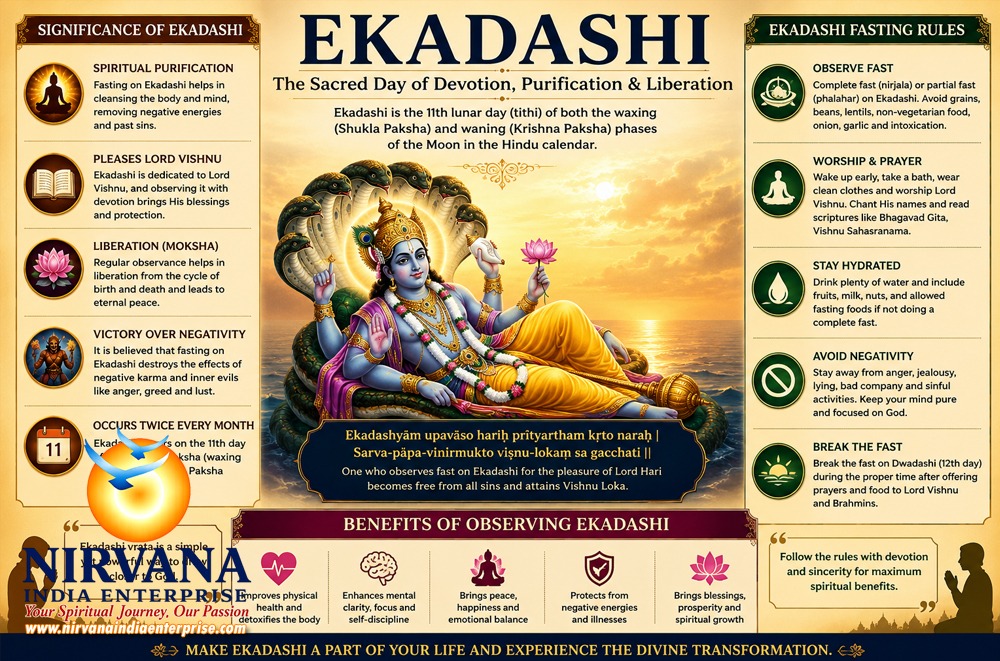
Among all fasting observances in Sanatana Dharma, Ekadashi is regarded as one of the most powerful and spiritually rewarding. Observed on the eleventh day of every lunar fortnight, Ekadashi is dedicated to Lord Vishnu and is considered a sacred day for fasting, prayer, meditation, self-discipline, and spiritual purification.
For thousands of years, saints, sages, and devotees have observed Ekadashi Vrat to cleanse the mind, control the senses, reduce karmic burdens, and receive the divine blessings of Lord Vishnu.
The greatness of Ekadashi is praised extensively in the Padma Purana, Skanda Purana, Bhavishya Purana, Narada Purana, and Bhagavata Purana. These sacred texts proclaim that observing Ekadashi with devotion grants immense spiritual merit and helps devotees progress toward Moksha (Liberation).
What Does Ekadashi Mean?
The Sanskrit word “Ekadashi” means “Eleventh.”
- Eka = One
- Dashi = Ten
Together, they signify the eleventh lunar day (Tithi).
Every lunar month contains two Ekadashis:
Shukla Paksha Ekadashi
Occurs during the waxing phase of the Moon.
Krishna Paksha Ekadashi
Occurs during the waning phase of the Moon.
Thus, there are usually 24 Ekadashis in a year, and occasionally 26 during Adhika Maas.
Why Is Ekadashi Considered So Sacred?
Ekadashi is considered highly auspicious for:
- Worship of Lord Vishnu
- Spiritual Discipline
- Meditation and Prayer
- Chanting Divine Names
- Reading Sacred Scriptures
- Charity and Service
- Purification of Body and Mind
The day encourages devotees to withdraw from worldly distractions and focus on spiritual growth and divine remembrance.
The Divine Origin of Ekadashi The Story of Ekadashi Devi
The Padma Purana narrates the story of the demon Mura, who terrorized the celestial beings and sages.
Lord Vishnu engaged Mura in a fierce battle. During the conflict, a divine feminine energy emerged from Lord Vishnu and destroyed the demon. Pleased with her victory, Lord Vishnu named her Ekadashi and granted a boon that anyone who observed fasting and devotion on this sacred day would be freed from sins and blessed with spiritual progress.
Thus, Ekadashi became one of the most important observances dedicated to Lord Vishnu.
Why Is Rice Avoided on Ekadashi?
One of the most distinctive aspects of Ekadashi fasting is the avoidance of rice and grains.
This practice has deep roots in scriptural traditions, Puranic legends, and spiritual symbolism.
Scriptural Belief Sins Reside in Rice on Ekadashi
According to traditional Vaishnava beliefs, sinful influences (Papa Purusha) are believed to reside in grains, especially rice, on Ekadashi.
Therefore, devotees abstain from rice and grain-based foods and instead focus on fasting, prayer, chanting, and worship of Lord Vishnu.
Ancient traditions state that avoiding grains on Ekadashi helps preserve spiritual purity and enhances the benefits of the vrata.
The Legend of Brahma and the Rice Grain
A popular traditional legend explains why rice is specifically avoided.
According to the story, a drop of sweat fell from the forehead of Lord Brahma and transformed into a demon. The demon sought a permanent place to reside.
Lord Brahma instructed him to reside in rice grains consumed by people on the sacred Ekadashi Tithi.
For this reason, devotees traditionally avoid rice on Ekadashi, believing that consuming it on this day diminishes the spiritual benefits of the fast.
Though symbolic, the story teaches purity, discipline, and respect for sacred observances.
Spiritual Meaning of Avoiding Rice
The deeper purpose behind avoiding rice is spiritual rather than merely dietary.
It symbolizes:
- Self-Control
- Sense Discipline
- Detachment from Material Comforts
- Mental Purification
- Devotion to Lord Vishnu
By voluntarily giving up staple foods, devotees cultivate spiritual awareness and strengthen their commitment to the divine path.
Spiritual Benefits of Observing Ekadashi
Purification of Mind and Body
Fasting helps cleanse physical and mental impurities.
Destruction of Negative Karma
Scriptures repeatedly praise Ekadashi as a powerful means of reducing accumulated karmic burdens.
Divine Grace of Lord Vishnu
Ekadashi is especially dear to Lord Vishnu, and worship performed on this day is believed to yield immense spiritual merit.
Improved Concentration
The simplicity of fasting promotes meditation, prayer, and scriptural study.
Progress Towards Moksha
Many Puranas declare that sincere Ekadashi observance helps devotees move closer to liberation.
Major Ekadashis Celebrated During the Year
1.Vaikuntha Ekadashi
The most celebrated Ekadashi among Vaishnavas. It is believed that the gates of Vaikuntha, the divine abode of Lord Vishnu, open for devotees on this day.
2.Nirjala Ekadashi
Considered the strictest Ekadashi fast, traditionally observed without food and water.
3.Devshayani Ekadashi
Marks the beginning of Chaturmas when Lord Vishnu enters His divine cosmic sleep.
4.Devutthana Ekadashi
Celebrates the awakening of Lord Vishnu after Chaturmas.
5.Mokshada Ekadashi
Associated with liberation and ancestral blessings.
6.Putrada Ekadashi
Observed for family well-being and progeny blessings.
7.Kamika Ekadashi
Known for destroying sins and granting spiritual merit.
8.Papankusha Ekadashi
Believed to remove accumulated karmic burdens and bestow divine blessings.
How Is Ekadashi Observed?
The observance varies according to age, health, and personal capacity.
Complete Fast
Some devotees abstain from all food.
Fruit Fast (Phalahar)
Many consume fruits, milk, and approved fasting foods.
Grain-Free Fast
Some devotees avoid only grains while consuming simple sattvic foods.
Foods Traditionally Allowed on Ekadashi
- Fruits
- Milk
- Curd
- Dry Fruits
- Coconut
- Sabudana (Sago)
- Rajgira (Amaranth)
- Singhara Flour
- Makhana (Fox Nuts)
- Potatoes
- Sweet Potatoes
- Rock Salt (Sendha Namak)
Rice, wheat, pulses, and grain-based foods are generally avoided.
Worship and Spiritual Practices on Ekadashi
Devotees spend the day engaged in:
Vishnu Puja
Offerings commonly include:
- Tulsi Leaves
- Flowers
- Fruits
- Incense
- Ghee Lamps
Chanting
Popular mantras include:
Om Namo Narayanaya
Om Namo Bhagavate Vasudevaya
Hare Rama Hare Krishna Maha Mantra
Scriptural Reading
Many devotees read:
- Bhagavad Gita
- Srimad Bhagavatam
- Vishnu Sahasranama
- Ramayana
Charity and Service
Acts of charity performed on Ekadashi are considered highly meritorious.
Importance of Dwadashi Parana
The Ekadashi fast is concluded on Dwadashi, the following lunar day, during the prescribed Parana time.
Proper completion of the fast is considered an essential part of the vrata and helps devotees receive the full spiritual benefit of the observance.
Ekadashi and the Great Bhakti Saints
Many revered saints emphasized the importance of Ekadashi:
- Sant Dnyaneshwar
- Sant Tukaram
- Sant Namdev
- Sant Eknath
- Meerabai
Their teachings encouraged devotees to dedicate Ekadashi to prayer, chanting, humility, and devotion.
Famous Ekadashi Pilgrimage Destinations in India
Ekadashi is considered especially auspicious for visiting temples dedicated to Lord Vishnu and His incarnations.
Tirumala Venkateswara Temple
One of the most visited pilgrimage destinations in the world and especially important during Vaikuntha Ekadashi.
Pandharpur Vitthal Rukmini Temple
The spiritual heart of Maharashtra and the center of Ashadhi and Kartiki Ekadashi celebrations.
Jagannath Temple
A major Vaishnava pilgrimage center and one of the Char Dham destinations.
Ranganathaswamy Temple
The foremost among the 108 Divya Desams and one of the holiest Vishnu temples in the world.
Badrinath Temple
A sacred Char Dham shrine dedicated to Lord Vishnu.
Guruvayur Temple
Often called the “Dwarka of the South” and renowned for Ekadashi celebrations.
Divya Desam Pilgrimage and Ekadashi
For devotees of Lord Vishnu, visiting the sacred Divya Desams is among the highest forms of pilgrimage.
The 108 Divya Desams are the holy Vishnu temples glorified by the Alwars in the Nalayira Divya Prabandham. Observing Ekadashi while undertaking a Divya Desam pilgrimage is believed to multiply spiritual merit and deepen devotion.
Popular Vishnu pilgrimage circuits include:
- 108 Divya Desam Yatra
- Chola Nadu Divya Desam Tour
- Pandya Nadu Divya Desam Tour
- Malai Nadu Divya Desam Tour
- Tondai Nadu Divya Desam Tour
- Vada Nadu Divya Desam Tour
- Nava Tirupati Temple Tour
- Pancha Ranga Kshetra Yatra
Ekadashi Pilgrimage Tours with Nirvana India Enterprise
Nirvana India Enterprise specializes in customized Vishnu Temple Tours and Ekadashi Pilgrimages across India.
Our popular spiritual journeys include:
- 108 Divya Desam Tours
- Nava Tirupati Temple Tour
- Tirupati Balaji Darshan Packages
- Srirangam Temple Pilgrimage
- Pandharpur Ashadhi & Kartiki Ekadashi Yatra
- Jagannath Puri Yatra
- Badrinath Pilgrimage Tour
- Char Dham Yatra
- Pancha Ranga Kshetra Tour
- Adi Shankaracharya Circuit Tour
Customized Ekadashi Special Temple Tours
Whether travelling individually, with family, senior citizens, or spiritual groups, we create personalized pilgrimage experiences focused on devotion, comfort, and spiritual fulfillment.
Conclusion
Ekadashi is much more than a fasting ritual. It is a sacred opportunity to purify the body, elevate the mind, strengthen devotion, and deepen one’s connection with Lord Vishnu.
Through fasting, prayer, chanting, scriptural study, and self-discipline, devotees transform an ordinary day into a powerful spiritual observance. The ancient tradition of avoiding rice, worshipping Lord Vishnu, and dedicating the day to divine remembrance continues to guide millions of devotees on the path of spiritual growth.
May every Ekadashi bring peace, prosperity, spiritual wisdom, and the divine grace of Lord Vishnu into your life.
Contact Us
WhatsApp: +91 9987404440 / +91 9892002006 / + 91 9224444455
Website: Nirvana India Enterprise
Pilgrimage Portal: Blessings on the Net
YouTube Channel: Blessings on the Net YouTube Channel
“Your Spiritual Journey, Our Passion.”
Discover the spiritual significance of Ekadashi, fasting rules, benefits, why rice is avoided, major Ekadashis, scriptural legends, famous Vishnu temples, Divya Desam pilgrimages, and the divine blessings of Lord Vishnu
Comments are closed