

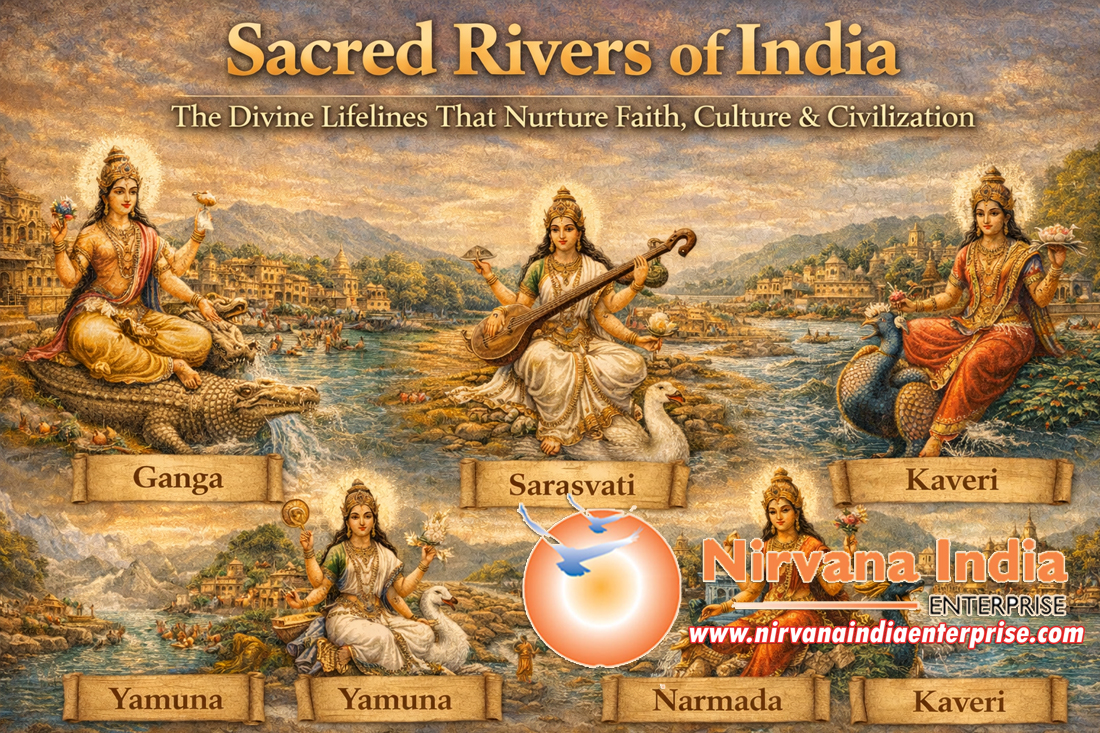
Sacred Rivers of India The Divine Lifelines That Nurture Faith, Culture & Civilization
Sacred Rivers of India The Lifelines of Spiritual Bharat
India is a land where even water becomes sacred when touched by divinity. Our ancient scriptures say “Nadyaḥ Pavitranam Pavitram” among all purifying elements, rivers are the holiest.
From the Himalayas to the ocean, every sacred river of India carries stories of gods, rishis, pilgrimages, and liberation.
This blog takes you through the most spiritually powerful rivers of India, their mythological origins, major temples, rituals, and also travel insights for pilgrims curated for the devotees of Sanatana Dharma.
1. Ganga The River of Liberation
Mythological Origin
Ganga descended from heaven to Earth when King Bhagiratha performed intense tapasya to free his ancestors. Lord Shiva softened her fall by holding her in his matted locks, letting her flow gently across Bharat.
Spiritual Significance
- Considered the mother of humanity.
- Bathing in Ganga believed to remove lifetimes of karmic impurities.
- Ganga water never spoils symbolic of purity.
Major Pilgrimage Cities
- Varanasi Kashi Vishwanath Temple, Manikarnika Ghat
- Haridwar Har Ki Pauri
- Rishikesh Gateway to Himalayas
- Prayagraj Triveni Sangam (Ganga + Yamuna + Saraswati)
Travel Tips
- Ideal months: October–March
- Best experiences: Ganga Aarti in Varanasi & Haridwar
2. Yamuna The River Loved by Krishna
Mythological Origin
Yamuna is the daughter of Surya and sister of Yama. Bathing in her waters grants freedom from fear of death (Yama-bhaya).
Spiritual Significance
- Closely connected to Sri Krishna’s childhood
- The river that witnessed Rasa Lila, Kaliya Mardanam, and thousands of divine leelas.
Major Pilgrimage Cities
- Mathura Vrindavan Krishna Janmabhoomi, Keshi Ghat
- Dwarka (Gomti ghat) Yamuna flows symbolically
- Allahabad region
Travel Tips
- Visit during Janmashtami or Braj Holi for a divine atmosphere.
3. Saraswati The Invisible Yet Eternal River
Mythological Origin
Saraswati is believed to flow underground according to Vedic texts. She appears at the Saraswati Ganga Yamuna Sangam in Prayagraj.
Spiritual Significance
- Symbol of knowledge, Vedas, and purity
- Bathing here believed to grant jnana (higher wisdom)
Important Spots
- Prayagraj Sangam (Triveni)
- Adibadri, Haryana
- Siddhpur, Gujarat
Travel Tip
Best time: Kumbh Mela, Magh Mela
4. Godavari The Ganga of South India
Mythological Origin
Lord Shiva released Godavari from his locks at Trimbakeshwar. Sage Gautama worshipped her to wash away a divine curse.
Spiritual Significance
- Bathing in Godavari during Kumbh (Sinhastha) considered extremely auspicious.
- Associated with Sage Gautama and Lord Rama (Panchavati).
Major Pilgrimage Cities
- Nashik Trimbakeshwar Jyotirlinga
- Rajahmundry Godavari Maha Pushkaram
- Panchavati Rama Sita Lakshmana stay
Travel Tips
- Best months: November February
5. Narmada The River Worshipped as a Goddess Herself
Mythological Origin
Born from Lord Shiva’s meditation. Called Shankari, daughter of Shiva.
Spiritual Significance
- One of the only rivers in India where parikrama (3,300 km) is performed.
- Ritual says just seeing Narmada grants the punya of bathing in Ganga.
Major Pilgrimage Routes
- Omkareshwar Jyotirlinga
- Maheshwar
- Amarkantak (origin)
Travel Tip
- Ideal for peaceful spiritual retreats.
6. Krishna River The River of the Southern Avatar
Mythological Origin
Said to have emerged from the toe of Lord Vishnu.
Spiritual Significance
- Associated with Datta Sampradaya, Pandharpur, Vijayawada Kanaka Durga Temple, Srisailam.
Major Pilgrimage Destinations
- Srisailam Mallikarjuna Jyotirlinga
- Pandharpur Vitthala Temple
- Vijayawada Kanaka Durga Temple
7. Kaveri The Sacred Mother of Tamil Nadu & Karnataka
Mythological Origin
Kaveri is believed to be daughter of Sage Kavera and incarnation of Lopamudra.
Spiritual Significance
- Known for purifying nature
- Runs through major temple towns
Major Pilgrim Spots
- Talakaveri (origin)
- Srirangapatna Ranganathaswamy Temple
- Srirangam World’s largest active temple
Travel Tip
- Avoid peak summer; best from September–February
8. Shipra River of Moksha
Spiritual Significance
- Famous for Mahakaleshwar Jyotirlinga, Ujjain
- Venue of Kumbh Mela
Major Pilgrimage Spot
- Ujjain Shipra ghats, Kaal Bhairav temple
9. Sindhu (Indus) The River That Gave India Its Name
Spiritual Significance
Symbol of strength, ancient civilization, Rigvedic culture.
Key Spots
- Ladakh region
- Sindhu Darshan Festival near Leh
10. Brahmaputra Son of Lord Brahma
Mythological Origin
Believed to be born from Lord Brahma’s lineage.
Spiritual Significance
- Major Shakti Peetha Kamakhya Temple lies on its banks
- Powerful tantric energy
Travel With Nirvana India Enterprise
For pilgrims seeking planned, peaceful, and authentic journeys across India’s sacred rivers:
- Customized Pilgrimage Circuits
- Holy River Bathing Rituals
- Temple Darshan Arrangements
- Transport + Hotels + Guides
- Senior Citizen-Friendly Tours
Whether it’s Ganga darshan in Kashi, Godavari dip in Nashik, Narmada parikrama, or Kaveri temple circuit,
Nirvana India ensures a spiritually fulfilling journey.
Comments are closed