

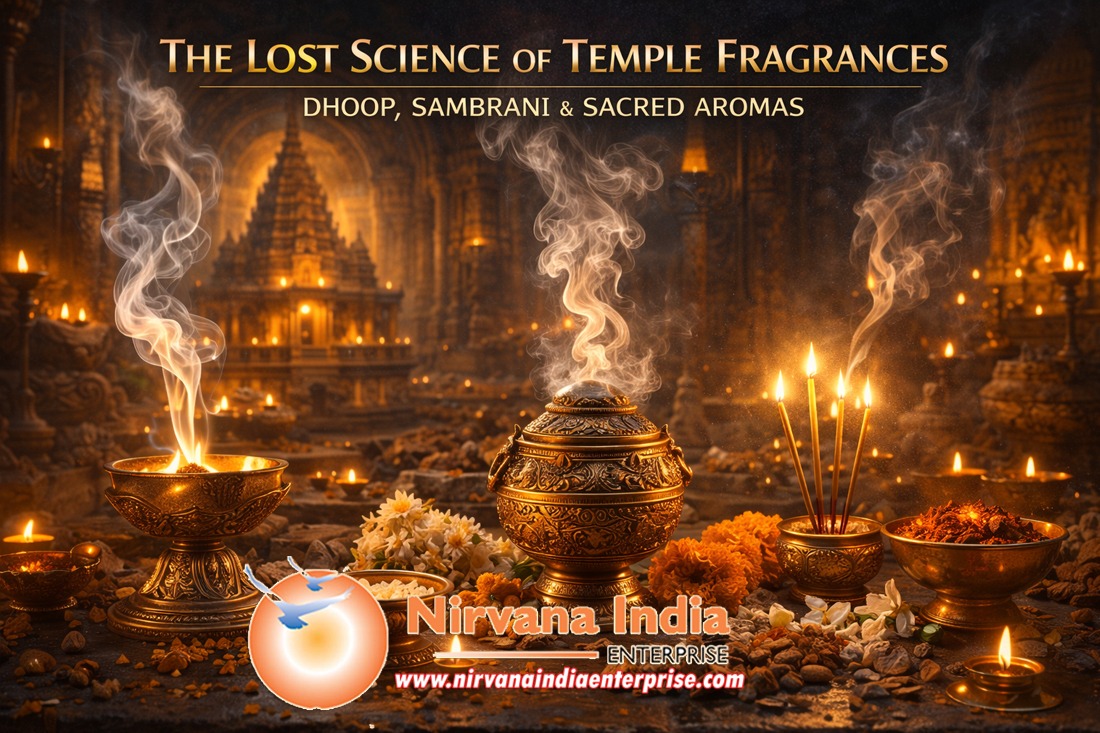
The Lost Science of Temple Fragrances Dhoop, Sambrani & Sacred Aromas
Step inside any ancient temple in India, and one thing instantly wraps around you the fragrance.
A mix of dhoop, sambrani, camphor, flowers, sandalwood and herbs…
It’s not just for smell.
It’s a science a forgotten one.
Temples weren’t only spiritual centers; they were energy laboratories, and fragrances were a key part of the experience.
Let’s rediscover this ancient wisdom.
1. Why Temples Use Fragrance in Rituals
Purification of Space
Dhoop smoke neutralizes airborne bacteria, molds, and impurities making the space energetically and physically clean.
Mind Conditioning
Fragrances instantly shift the human mind from restless to receptive.
They prepare you for prayer, meditation, and silence.
Activating the Nadis (Energy Channels)
Certain scents stimulate specific chakras and pranic pathways.
Enhancing Idol Energy (Prana Prathishta)
After consecration, fragrances help maintain the vibrational field around the deity.
Aromatherapy long before its time
India practiced scent-based healing thousands of years before it became “modern wellness.”
2. Temple Fragrance Types & Their Purpose
Sambrani (Benzoin Resin)
- Purifies the atmosphere
- Relaxes the nervous system
- Enhances meditation
- Drives away negative energies
Sambrani is one of the oldest ritual substances used in temples.
Dhoop Sticks (Herbal Resin Cones)
Usually made with neem, guggal, cow ghee, coconut husk, and herbs.
Used for:
- Cleansing aura
- Healing respiratory issues
- Creating a sacred mood
Camphor (Karpooram)
Symbolizes burning the ego.
But scientifically:
- Opens nasal channels
- Clears mental fog
- Repels insects
- Purifies energy instantly
Temple Flowers (Lotus, Champa, Jasmine, Parijata)
Not used for beauty but for frequency.
Flowers vibrate at high natural frequencies and enhance the sanctity of the deity space.
Sandalwood Paste
- Cools the body
- Calms mental chatter
- Used to activate Ajna Chakra (Third Eye)
3. Why Temple Fragrances Work So Powerfully
Ancient architects designed temples with:
- high ceilings
- stone corridors
- ventilated sanctums
- closed Garbha Grihas
This allowed fragrances to stay, circulate, and permeate both the structure and the visitor.
The walls actually absorb sacred aromas over decades creating an energetic imprint.
Sit inside a 1000-year-old temple and breathe…
You’ll feel the fragrance of centuries.
4. The Forgotten Science Behind Dhoop & Sambrani
Antibacterial
Sambrani smoke kills 92% of airborne bacteria (proven in modern lab studies).
Anti-stress
Temple incense reduces cortisol levels and balances the limbic system.
Atmospheric Ionization
Smoke releases negative ions, improving mood and energy.
Sound Amplification
When combined with mantras, fragrance increases the vibrational density of the space.
Temples were the original multi-sensory healing spaces.
5. Modern Life & The Lost Fragrance Traditions
Today, artificial incense sticks, cheap chemicals, and perfumed oils have replaced traditional blends.
But the original recipes are still used in:
- Ancient temples
- Certain mutts and ashrams
- Traditional Vaidika homes
These are formulas passed down for centuries.
Travel Brief (Nirvana India Enterprise)
AtNirvana India Enterprise, we curate spiritually rich temple journeys to India’s most powerful geomagnetic hotspots from Chidambaram to Arunachalam, Srisailam to Kedarnath. Our guided circuits ensure travelers experience the subtle energies, heritage stories, and sacred rituals these unique temples offer.
Comments are closed